Fukushima at 15: When a Fast Disaster Becomes a Slow One, and the Law Looks Away
Fifteen years since Fukushima. Of 880 tons of fuel debris, only 0.9 grams recovered. This piece frames Fukushima as a fast-to-slow disaster hybrid, cross-comparing Korea's climate ruling with Japan's immunity verdict to ask: why are courts bold on future risk yet timid on past harm?
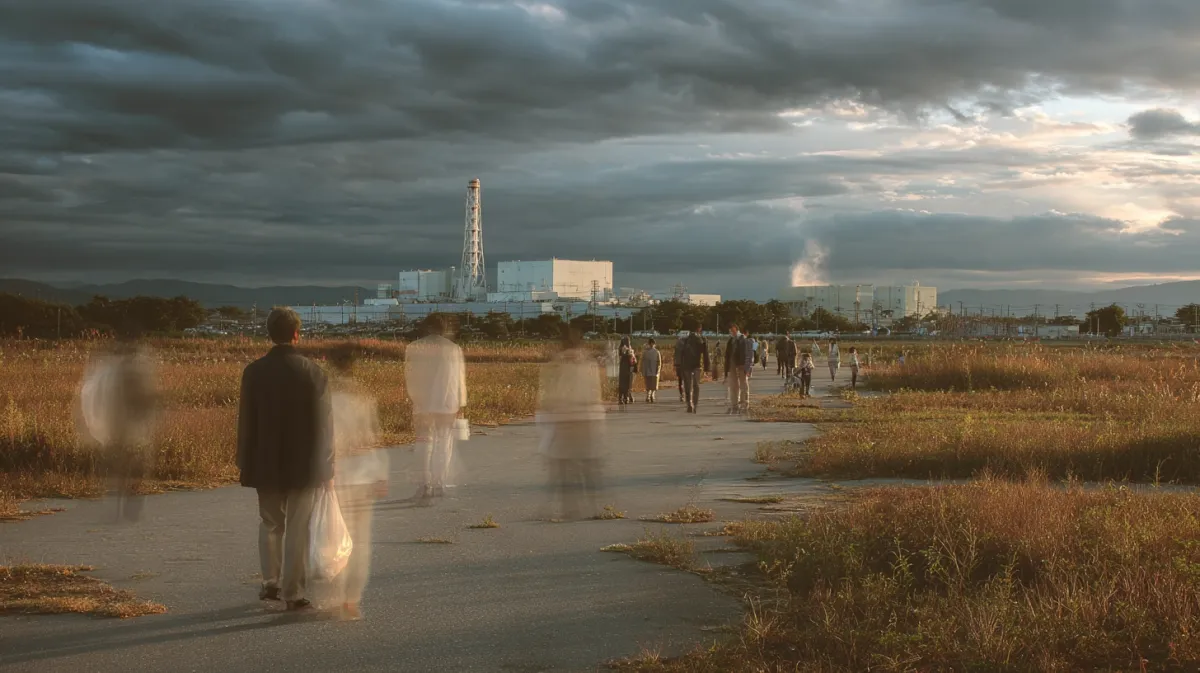
At 2:46 PM on March 11, 2011, a magnitude 9.0 earthquake struck roughly 70 kilometers off Japan's Oshika Peninsula. A 14-meter tsunami slammed into the Fukushima Daiichi Nuclear Power Plant. Reactors 1 through 3 melted down. Fifteen years later, approximately 880 metric tons of nuclear fuel debris still sits inside those ruined buildings. The amount recovered so far: 0.9 grams. That ratio — 880 tons versus less than a gram — is the most honest metric Fukushima has to offer.
But there's a fact even more stubborn than those numbers. Around 26,000 people still can't go home. The fast disaster of 2011 has spent 15 years morphing into a slow one. And the moment a disaster goes slow, it becomes a human rights problem.
Fast Disaster, Slow Disaster
I recently wrote a piece — "Climate Crisis Is Not an Environmental Issue. It's a Human Rights Issue" — cross-referencing the International Court of Justice's 2025 advisory opinion on climate change with South Korea's Constitutional Court 2024 ruling on the country's carbon neutrality law. The argument was simple: climate damage hits the vulnerable first, and the bill gets passed to future generations. Those with air conditioning, insurance, and the means to relocate survive. Those without don't.
Fukushima is the mirror image of that argument. If climate change is a slow disaster from start to finish, Fukushima is a hybrid — a fast disaster that has quietly shapeshifted into a slow one. The physical wreckage of the fast disaster is still grotesquely visible: 880 tons of debris, an ocean receiving treated radioactive water. But the people harmed by it have become invisible. The March 2011 explosion was fast. The evacuation order was immediate. About 160,000 people were forced from their homes. But over 15 years, the disaster changed character. The memory of the blast fades; the damage doesn't. Contaminated water is still being discharged. The fuel debris may take a century to fully remove. When Japanese citizens were asked whether the government's 2051 decommissioning target was achievable, 60 percent said no. Only 7 percent said yes.
The cruelest feature of a slow disaster is that its victims gradually disappear from view. People who were front-page news 15 years ago are now footnotes in statistical tables. And that erasure from visibility — not the radiation, not the debris — is the core mechanism of the human rights violation. What makes it worse: the contaminated water Japan's operators dumped into the ocean doesn't stop at national borders. It affects everyone along the Pacific Rim.
Two Courts, Two Answers
The clearest window into Fukushima's human rights problem is the courtroom record. This is where the structural contrast with climate justice cuts deepest.
In August 2024, South Korea's Constitutional Court ruled that the country's Carbon Neutrality Act was unconstitutional. The law set targets for 2030 (at least 35 percent reduction) and 2050 (net zero), but left the 19 years in between completely blank — no binding intermediate milestones. The court applied what Korean constitutional doctrine calls the "prohibition of insufficient protection": when the state has an obligation to protect a fundamental right, and the protection it offers is manifestly inadequate, that's a constitutional violation. The ruling explicitly called out the transfer of burdens to future generations.
At roughly the same time, Japanese courts were moving in the opposite direction.
In June 2022, Japan's Supreme Court Second Petty Bench rejected state liability in four class-action lawsuits filed by Fukushima evacuees. Of the four justices on the bench, only Mamoru Miura dissented — with a 29-page opinion that remains one of the most cogent arguments for state accountability in nuclear disaster law. The majority held that the scale of the tsunami was unforeseeable. In June 2025, the Tokyo High Court went further, overturning a ¥13.3 trillion ($9.2 billion) damages ruling against former TEPCO executives. Same logic: the tsunami couldn't have been foreseen. Then, on January 22, 2026, the Supreme Court dismissed appeals in nine additional class-action cases, effectively sealing state immunity.
Why does this matter from a human rights standpoint?
The two rulings are, admittedly, different species of law. The Japanese Supreme Court dealt with tort liability and state compensation — money someone has to pay. The Korean Constitutional Court dealt with legislative duty — a policy direction someone has to set. The judicial burden of ordering a payout is fundamentally different from ordering a law to be written. But the comparison holds for one critical reason: both cases address the state's obligation in the face of structural risk. How a judiciary interprets that obligation determines whether victims have rights or don't. Same question, two faces.
There's a structural logic to this asymmetry — though it doesn't apply universally, and there are courts that have aggressively awarded compensation for past harm. But the pattern visible in these two rulings is hard to ignore. Courts are relatively bold when they look forward. Imposing a legislative obligation for future risk doesn't hit anyone's budget today. Courts are cautious when they look backward. Acknowledging state liability for a past disaster triggers trillions of yen in immediate fiscal exposure. Future obligations are abstract. Past payouts are concrete. The law is generous with promises and stingy with checks. Even when the legal algorithms differ, the result is the same: victims' rights erode in the gap between the two.
"Unforeseeability" as Legal Technology
The logic Japanese courts deployed — "unforeseeability" (予見可能性の否定) — deserves a closer look. It isn't just a legal finding. It's a sophisticated technology for immunizing structural risk.
A nuclear power plant, by design, presupposes extreme danger. It's a facility that controls nuclear fission, which means the possibility of losing control is baked into the engineering from day one. Japan's Nuclear Regulation Authority and the IAEA have both formally acknowledged the possibility of design-basis exceedance events. Yet the court ruled that "a tsunami of that magnitude could not have been foreseen." The logic: structural risk is acknowledged, but specific outcomes are unforeseeable.
In strict legal terms, inherent risk doesn't equal foreseeability of specific outcomes. Knowing that planes can crash doesn't mean you foresaw a particular crash on a particular day.
But a nuclear plant isn't an airplane. The spatiotemporal scale of a nuclear accident is effectively unbounded. 880 tons of debris. A hundred-year decommission. Three decades of radioactive water discharge. For a facility capable of this scale of harm, the argument that "we didn't foresee the exact height of the wave, therefore no liability" suffers from a proportionality deficit. The risk is enormous; the threshold for immunity is absurdly low.
Elizabeth Fisher's concept of Probabilistic Risk Management Duty — systematized in Risk Regulation and Administrative Constitutionalism (Hart Publishing, 2007) — speaks directly to this problem. Fisher's core argument: the right question isn't "did you foresee it?" but "did you take precautionary measures proportionate to the magnitude of risk?" Regulators have an obligation to act based on probabilistic risk assessments. Apply that frame, and the Japanese court's immunity logic collapses. It was asking the wrong question. Not foreseeability. Adequacy of preparedness.
Alfred North Whitehead wrote in Adventures of Ideas (1933) about the stubbornness of fact — the way brute reality resists reinterpretation, selective emphasis, and theoretical convenience. That concept maps precisely onto Fukushima's legal reality. The 880 tons of debris and 26,000 displaced residents are stubborn facts that no legal reasoning can erase. Yet Japan's judiciary, through the interpretive device of "unforeseeability," managed to erase state responsibility in the face of those facts. Facts are stubborn. But the law, it turns out, can be more stubborn still.
This connects directly to South Korea's situation. As of 2026, the Korean government has finalized its 11th Basic Plan for Electricity Supply and Demand, which calls for two new large-scale reactors and one small modular reactor (SMR). So the questions are unavoidable: What has Korea's nuclear compensation framework learned from Japan's failure? If an accident occurs, how are victims' rights guaranteed? Could Japan-style "unforeseeability" immunity repeat itself in Korea?
The answers aren't reassuring. Korea's Nuclear Damage Compensation Act caps operator liability (Articles 3 and 3-2), and the scope of state intervention for damages exceeding that cap is ambiguous at best. As Fukushima demonstrated, the actual cost of a nuclear accident blows past any liability cap. Building new reactors without addressing this legal infrastructure means passing on not just radioactive waste but legal uncertainty to future generations.
What International Law Says — and Can't
Zoom out from domestic courts to the international stage, and Fukushima's human rights landscape gets even more tangled.
In July 2025, the ICJ unanimously adopted a historic advisory opinion on climate change obligations. Two key holdings: states have a duty to protect the environment from greenhouse gas emissions with due diligence, and the Paris Agreement's 1.5°C target carries legal force. Here's the interesting part: in building its reasoning, the ICJ cited its own 1996 advisory opinion on the legality of nuclear weapons, which had extended the duty not to cause serious environmental harm into a "global environmental concern."
Could the same principle apply to contaminated water discharge? Logically, yes. UN Human Rights Council special rapporteurs sent a joint letter to Japan in May 2025, warning that the discharge poses environmental and human rights risks. At the Universal Periodic Review, the Marshall Islands representative raised contaminated water as a direct human rights issue. Greenpeace argued violations of UNCLOS and the London Protocol. The 2026 discharge volume has been expanded to 62,400 tons annually, with eight rounds of discharge planned this year.
But international law's structural limitations are real. ICJ advisory opinions aren't binding. The Human Rights Council has no enforcement mechanism. The IAEA confirmed that tritium levels in the discharged water fall below regulatory limits, and China's nuclear energy authority reached similar conclusions in its independent monitoring. There's genuine tension between the scientific data and the human rights concerns, and honest journalism requires grappling with that tension rather than collapsing it into a simple narrative.
Here's where I come down on this. I'm skeptical that international law can provide meaningful protection for Fukushima's victims. The UN system is superb at declaring norms and structurally incapable of converting those norms into actual relief. Japan passed a Victims Support Act in 2012; 14 years later, it remains largely unimplemented. The UN Special Rapporteur on internally displaced persons declared that forced and voluntary evacuees cannot be treated differently. Japan's government maintains exactly that distinction, and continues to cut support for voluntary evacuees.
Two Clocks: Decommissioning Time vs. Human Rights Time
Two clocks are ticking in Fukushima. One tracks decommissioning. The other tracks human rights. They don't keep the same time.
The decommissioning clock is technical. This year, TEPCO successfully tested a 22-meter snake-like robotic arm — 4.6 tons, designed to reach debris in an environment measuring hundreds of sieverts per hour. The IAEA hosted webinars on AI-assisted decommissioning. Digital twins and autonomous robots are being deployed. Technology is advancing. But full-scale debris extraction has been pushed back to 2037 at the earliest, and full remediation could take a century.
The human rights clock moves differently. While technology talks in centuries, displaced residents are living right now. For people who haven't been home in 15 years, the promise of "decommissioning by 2051" has the same structure as the climate policy Korea's Constitutional Court criticized: a target exists, but the pathway doesn't. The 2050 promise is grand; the concrete plan for 2026 through 2050 is blank. Korea's court called that "insufficient protection." The same label fits Japan's response to Fukushima victims.
South Korea's Basic Income Party noted in a March 11 statement that "expanding nuclear power passes unbearable costs and risks onto future generations." The legal translation of that sentence is intergenerational justice. Germany's Federal Constitutional Court coined a term for it in 2021: Freiheitsvorsorge — the preemptive consumption of future generations' freedom. That concept speaks directly to Fukushima's present. A hundred years of decommissioning, three decades of water discharge, tens of thousands who can never return — this isn't an abstract future burden. It's intergenerational cost-shifting already in progress. Korea's Constitutional Court adopted the same logic in 2024. Fukushima is the most concrete proof that the abstract principle is real.
Of course, Korea's own ruling hasn't been fully implemented either. The February 28, 2026 deadline for legislative revision passed without the amendment being completed. The gap between declaration and implementation isn't just Japan's problem.
What Remains
The question we face on Fukushima's 15th anniversary isn't "is nuclear power safe?" That's an engineering question, and engineering answers in probabilities. The real questions are these: When an accident happens, are victims' rights protected? Does the state take responsibility? Can the international community provide effective remedy?
Fifteen years of evidence delivers uncomfortable answers to all three. Victims' rights have been eroded by legal immunity. The state dodged responsibility through the logic of "unforeseeability." The international community declared norms but couldn't enforce them.
And there's one more thing to confront. The law doesn't receive facts as they are. It adjudicates them — translates them into its own language. 880 tons of debris is a physical fact, but the moment it enters a courtroom, it becomes "manageable material" or "a variable beyond the scope of foreseeability." 26,000 displaced residents and communities across the Pacific living with contaminated water represent human suffering, but in a court filing they become "absence of causal connection under the State Compensation Act." What disappears in that translation between fact and legal truth — tracking that is journalism's job.
What Whitehead called stubborn facts are exactly this: things that resist interpretation and convenience, that survive legal translation and still demand to be faced. South Korea is building new nuclear plants. That's an energy policy choice, but it's also a human rights policy choice. Pursuing new reactors while ignoring gaps in the compensation framework reproduces the same structure — passing radioactive waste and legal uncertainty alike to future generations. Technology won't fix that structure. Only law, institutions, and democratic deliberation can.
I agree that the AI era demands enormous amounts of electricity. I understand why governments are looking at nuclear power when alternatives seem insufficient. My argument isn't against nuclear power per se. It's that before we build, we need to think carefully — one more time — about the rights of the people who will live with the consequences.
Fukushima's human rights problem isn't Japan's alone. It's a question for every country that operates nuclear plants, and every government planning to build them. Rights left underprotected today become someone's disaster tomorrow.