A Verdict No One Can Take Seriously
South Korea's former First Lady Kim Keon-hee received 20 months for corruption while her husband sits in prison for insurrection. Judge's verdict reveals judicial tolerance for power-related crimes, applying lenient standards to elites while ordinary citizens face years for lesser offenses.
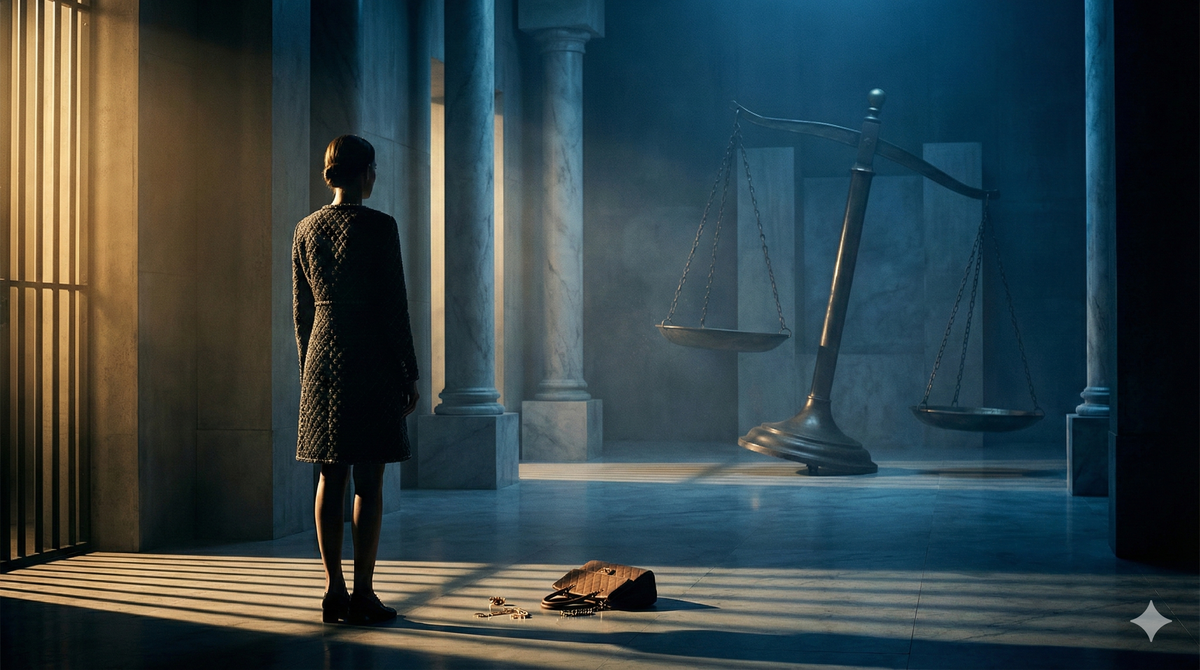
Why the 20-Month Sentence for Kim Keon-hee Defies Public Reason
On December 3, 2024, South Korean President Yoon Suk-yeol declared martial law in what would become one of the shortest and most catastrophic political miscalculations in modern democratic history. The decree lasted six hours before the National Assembly unanimously voted 190-0 to lift it. Within weeks, Yoon was impeached, and by early 2025, he was arrested and detained on charges of insurrection. What began as an attempted power grab ended as a constitutional crisis that exposed the fragility of South Korea's democratic institutions and the willingness of certain actors to overturn them.
Throughout Yoon's presidency, his wife Kim Keon-hee had been a parallel source of controversy. Long before the insurrection attempt, she was implicated in stock manipulation schemes involving Deutsch Motors, accused of fabricating credentials, and caught accepting luxury goods including a Chanel bag and a Graf necklace from religious organizations seeking influence. Her conduct as First Lady - staging fake photo ops disguised as humanitarian activities, continuing luxury shopping sprees while the government preached austerity, and repeatedly flouting diplomatic and civic norms - painted a portrait of systematic ethical disregard. These were not isolated lapses. They formed a pattern: the persistent abuse of proximity to power, coupled with a striking absence of accountability. On January 28, 2026, as her husband sat in detention for attempting to destroy the constitutional order, Kim Keon-hee stood trial not as a private citizen but as the central figure in years of legal, ethical, and political controversy. Prosecutors demanded 15 years. The court sentenced her to 20 months.
The Context Was Already Abnormal
By the time the verdict was delivered, the context itself had become surreal. The President of South Korea was imprisoned on insurrection-related charges. His wife, the former First Lady, stood in court as the focal point of years of ethical, legal, and political controversy. Prosecutors demanded 15 years. The court sentenced her to 20 months. The gap between these two numbers is not merely technical. It is political. And to many observers, it is indefensible.
A Record That Existed Long Before She Became First Lady
Kim Keon-hee's legal and ethical controversies began long before her husband came to power. Media outlets extensively reported allegations of stock manipulation, credential fabrication, and opaque financial dealings - issues that were never properly resolved.
During her tenure as First Lady, the controversies did not subside but intensified. Kim staged fake photo shoots disguised as official or humanitarian activities, continued luxury shopping during a period when the government publicly emphasized austerity, and repeatedly violated the diplomatic and civic norms expected of her role. Each issue, taken alone, might not justify severe punishment. But together, they constitute an unmistakable pattern: the systematic abuse of proximity to power, coupled with a striking absence of accountability.
Why a 15-Year Demand Became 20 Months: Judge Woo In-seong's Logic and Its Limits
Prosecutors viewed this case as systematic corruption - not isolated errors. The 15-year demand was based on this perspective. Judge Woo In-seong rejected that frame.
Judge Woo In-seong, presiding judge of Seoul Central District Court Criminal Division 27, recognized guilt only within a narrow scope: accepting luxury goods related to the Unification Church. The core charges that could have implicated Kim Keon-hee in the political and financial mechanisms behind the presidency were all dismissed.
Regarding the Deutsch Motors stock manipulation, Judge Woo stated: "None of the members of the manipulation group testified that they directly informed the defendant about the manipulation. There is no data showing what role the defendant performed in the manipulation."
Regarding the Myung Tae-kyun opinion polls, he ruled: "If the polls were at Kim Keon-hee's instruction, she should have given directions on whether to disclose the questionnaire content before implementation. After the polls, she should have given instructions on distribution targets after receiving the results. The record shows no such circumstances."
This logic appears to follow legal principles formally. But in substance, Judge Woo set the evidentiary threshold impossibly high. Corruption near power operates without explicit quid pro quo or direct orders. Judge Woo's logic renders this structural characteristic essentially unpunishable from the outset.
The result is a sentence that appears disconnected from: the scale of the allegations, the period over which they occurred, and the defendant's unparalleled access to state power. An unavoidable question arises for outside observers: whom exactly is this verdict trying to persuade?
Proportionality Is the Central Issue
This is not a demand for vengeance. It is a demand for proportionality. In South Korea, ordinary citizens receive multi-year sentences for far less serious crimes.
For document forgery to obtain employment or fabricate academic credentials, courts sentence 6 months to 2 years imprisonment. Minor financial fraud involving tens of millions of won: 2 to 4 years. Indirect involvement in stock manipulation by collaborating with manipulation groups: 3 to 7 years. For Capital Markets Act violations involving undisclosed information trading in the 100 to 500 million won range, the baseline sentence is 1 to 4 years.
Against this backdrop, the 20-month sentence for a former First Lady goes beyond leniency. Following a 15-year prosecutorial demand, this sentence signals something far more troubling: a judicial calculus in which status quietly mitigates accountability.
Judge Woo In-seong and His Pattern in Politically Sensitive Cases
Judge Woo In-seong has been evaluated in legal circles as a principled jurist. In 2014, he acquitted a Ssangyong Motor worker who had been dismissed. He was praised for checking excessive exercise of state power. In 2019, the Seoul Bar Association selected him as an outstanding judge.
However, his recent rulings in politically sensitive cases have shown a tendency to favor the conservative camp. The most glaring example is the Jang Young-ha attorney case.
On January 24, 2025, Judge Woo acquitted attorney Jang Young-ha. During the 2022 presidential election, Jang had publicly disseminated demonstrably false information about candidate Lee Jae-myung: allegations of organized crime connections and acceptance of 2 billion won in bribes. Judge Woo ruled:
"I find that the facts publicly stated by the defendant regarding bribery are false. However, it appears the defendant believed the stated facts to be true. There is insufficient evidence that the defendant was aware of their falsity."
What is the essence of this logic? The judge acknowledges the statements are false. But the subjective defense of "I believed it" alone results in acquittal.
In October 2025, the appellate court reached the opposite verdict. The Seoul High Court overturned the original ruling, sentencing attorney Jang to 1 year imprisonment with 2 years probation. "As a legal professional with 40 years of experience, he possessed far more legal knowledge than ordinary people. He held a press conference without proper verification procedures and without objective evidence. At minimum, he recognized the possibility that the statements might be false and proceeded to disseminate them anyway."
Judge Woo's first-instance judgment was completely reversed on appeal. But by then, the election had already been held. The false information had already influenced voters.
This Is Judicial Obstruction of Democratic Recovery
I believe this verdict transcends mere legal interpretation. South Korea now stands at a historic crossroads: it must conclude the insurrection and restore democracy.
The 20-month sentence for Kim Keon-hee, delivered at this moment, once again demonstrates the judiciary's structural tolerance for power-related corruption. Judge Woo In-seong's acquittal of attorney Jang Young-ha and his lenient conviction of Kim Keon-hee share the same logical structure.
For those in power and power defenders, "no direct evidence" and "I believed it" lead to acquittal or light punishment. For ordinary citizens, the law is applied strictly based on "circumstantial suspicion." This is not legal principle—it is class-based discrimination.
What is even more serious is the timing. This lenient verdict for an insurrectionist president's wife came precisely when Korean society is moving toward insurrection accountability and democratic recovery. I read this as the judiciary assuming the role of shield for insurrectionist forces.
I view this as intentional political intervention. And it will have a severely detrimental impact on South Korea's democratic recovery.
Structural Problems in Korea's Judiciary: The Double Standard in Burden of Proof
Beyond Judge Woo In-seong's individual rulings, Korea's judiciary has long faced criticism for applying different evidentiary standards to the powerful versus ordinary citizens. This criticism has been consistently raised within and outside legal circles, in civil society, and in the media.
The first pattern is the selective application of "direct evidence" requirements. For the powerful, "lack of direct evidence" becomes grounds for acquittal—as in Kim Keon-hee's acquittals on stock manipulation and opinion poll charges. For ordinary people, "circumstantial suspicion" tends toward guilt presumption.
The second pattern is selective acceptance of the "I believed it" defense. Attorney Jang Young-ha disseminated demonstrably false information, yet received acquittal in the first instance because "he believed it." When ordinary citizens are defrauded and "believed" what they were told, courts still assign them liability for negligence.
The third is deepened distrust following the judicial manipulation scandal. After investigations into judicial manipulation during Chief Justice Yang Seung-tae's tenure revealed in 2018, criticism has intensified both within and outside legal circles that politicization and power orientation within Korea's judiciary has become increasingly visible. The most representative example is Chief Justice Cho Hee-dae's lightning-fast processing of candidate Lee Jae-myung's Supreme Court appeal in 2025: referral to full bench within 2 hours of case assignment, verdict delivered in 9 days. This raised suspicions that the judiciary is adjusting verdict timing to match political calendars.
Why Public Trust Collapses Here
Courts do not lose legitimacy through harshness. They lose legitimacy when outcomes appear predetermined by hierarchy.
To many Koreans, and to a growing number of international observers, this verdict delivers a simple message: there are crimes, and then there are crimes committed near power.
A former First Lady whose conduct had already eroded public trust received a sentence that appears almost unrelated to the prosecution's assessment or to comparable cases. At such moments, distrust is not emotional. It is rational.
What should have been different? If Judge Woo In-seong had genuinely sought to implement proportionality, a minimum of 5 to 7 years actual imprisonment would have been appropriate—considering the repeated transgressions using First Lady status, the social impact, and sentencing levels in similar cases.
Judge Woo should not have used "unproven quid pro quo" and "absence of direct orders" as exculpatory shields. Power-related corruption does not operate through explicit transactions in the first place. When legal principles fail to keep pace with actual power dynamics, that is the failure of legal principles.
The case assignment system for politically sensitive cases also requires reexamination. Does the court's random computerized assignment actually ensure political neutrality? Or is there a structural tendency for certain types of cases to concentrate with judges of particular inclinations? This must be transparently verified.
Why This Is a Failure of Democratic Proportionality
This is why this verdict is not debated as a legal footnote. People understand it as a failure of democratic proportionality. No amount of procedural explanation can fully restore this.
What Judge Woo caused to be lost is not merely trust in one case. What was lost is the fundamental premise that "in this society, law operates equally." Korean society is now witnessing that this premise is a fiction.
A Verdict That Failed to Secure Social Legitimacy
This verdict may be legally valid, but it has failed to secure social legitimacy.
The 20-month sentence for Kim Keon-hee reveals how close power and law actually are—and how leniently that proximity operates for certain individuals.
What is more serious is the double standard in legal application demonstrated by Judge Woo In-seong, who delivered this verdict. Judge Woo accepts the "I believed it" excuse from conservative camp figures. He treats "absence of direct evidence" as exoneration for the powerful. He does not apply the same standards to ordinary citizens.
This is precisely why so many cannot take this verdict seriously. And this is precisely why this verdict will be remembered as a judicial obstacle blocking Korean society's efforts to liquidate insurrection and restore democracy.
When law becomes a shield for power, it ceases to be law. It becomes merely an instrument of domination.