The MoU That Turned AI-RAN Into a Weapon in the 6G Standards War
SK Telecom and Ericsson signed a 5-year AI-RAN and 6G MoU right after MWC 2026. Clean press release, optimistic quotes. But this isn't a tech deal — it's a declaration of allegiance, and the coalition is already fracturing over whose chip makes it real.
Ray | Digital Journalist | awesome.ai.life@gmail.com | March 19, 2026
On March 19, 2026, SK Telecom (NYSE: SKM) and Ericsson (NASDAQ: ERIC) signed a Memorandum of Understanding to collaborate on AI-powered network technologies. The agreement runs through March 2, 2031 — five years. It covers five domains: AI-RAN (AI Radio Access Networks), 5G advancement, open and autonomous networks, zero-trust security, and 6G standardization. The ink dried in Seoul before Barcelona had even cooled off from MWC 2026.
The press release is clean. The executive quotes are reassuringly optimistic. But read this deal as a straightforward tech partnership, and you've missed the story entirely.
The Seismic Shift MWC 2026 Revealed
MWC 2026 at Fira Gran Via in Barcelona was unlike any telecom trade show before it. One phrase echoed across every booth, every keynote, every side conversation: AI-native. The message was the same everywhere — the network is no longer a pipe that carries data. It has to become the platform on which AI runs.
NVIDIA made it official at MWC 2026: 6G must be AI-native from the ground up. Networks need to embed AI directly into their architecture, transforming telecom infrastructure into intelligent, software-defined systems. This wasn't just rhetoric. T-Mobile demonstrated simultaneous AI and RAN processing on NVIDIA's AI-RAN platform. SoftBank pulled off a 16-layer massive MIMO field trial running on fully software-defined 5G.
Ericsson is right at the center of this. At MWC 2026, Ericsson — working with partners including Qualcomm — was building platforms to integrate AI capabilities across RAN, edge, and core, with a 6G commercialization roadmap targeting 2029. The first major partnership Ericsson inked after Barcelona? SK Telecom.
That's not a coincidence. That's a calculation.
What Yu Takki and Mårten Lerner Actually Signed
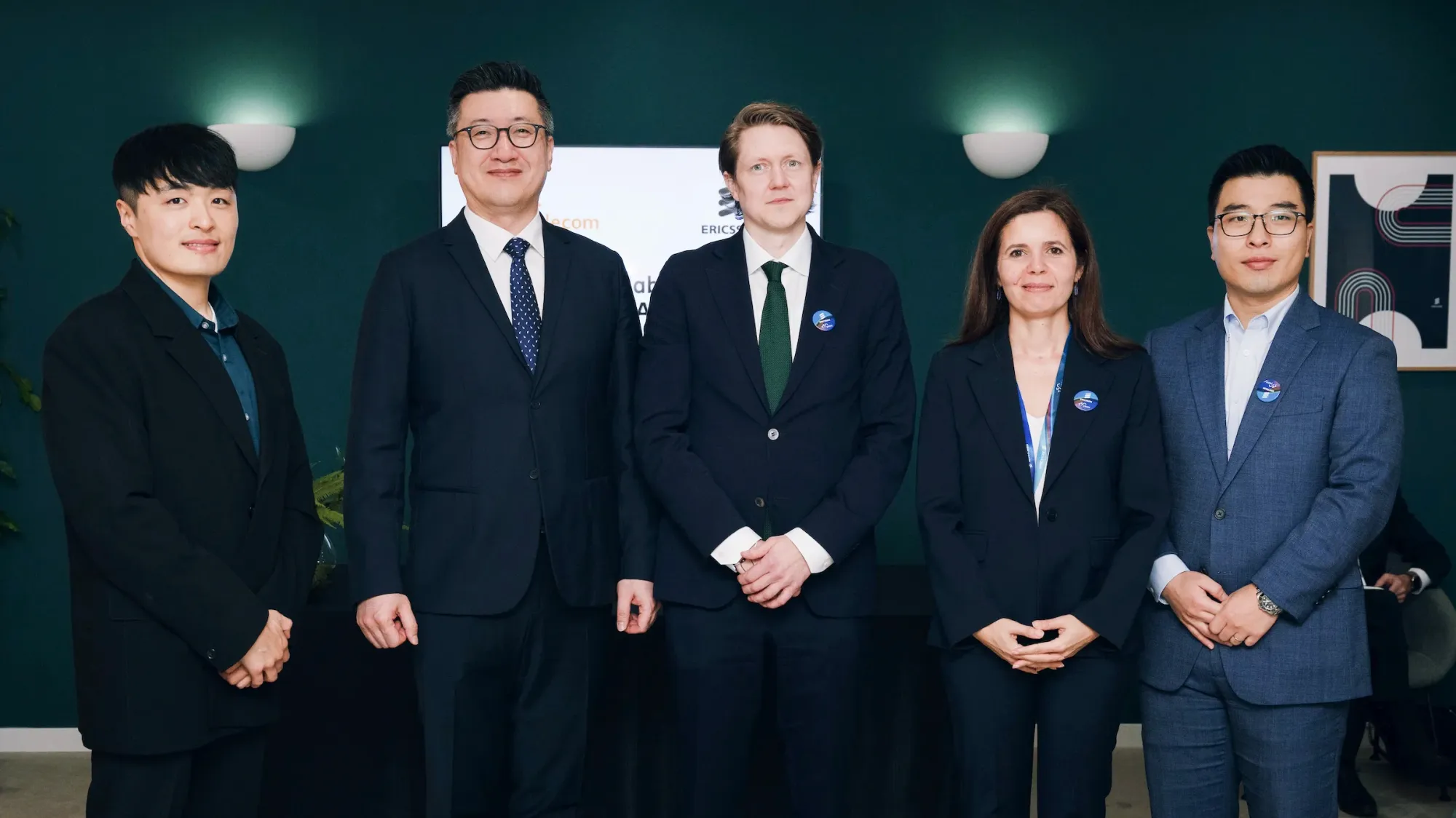
The signatories were Yu Takki, Head of Network Technology at SK Telecom, and Mårten Lerner, Head of Networks Strategy and Product Management at Ericsson. Look past the ceremonial handshake and into the technical terms of what they agreed to, and the agenda becomes clear.
AI-RAN means the network learns and predicts channel conditions autonomously, optimizing itself in real time. This isn't "putting AI on the network." The network itself becomes the learner. Extreme MIMO pushes data throughput to its limits by coordinating dozens — sometimes hundreds — of antennas simultaneously. ISAC (Integrated Sensing and Communication) uses signal transmissions to detect objects, track movement, and map the surrounding environment. Your telecom tower becomes a radar.
This isn't a shopping list of cool features. SKT and Ericsson aren't trying to build a faster network. They're building a network that thinks — that learns, secures itself, and senses its environment. And they want to own the standard that defines how that network works.
Yu Takki put it plainly: "Our collaboration with Ericsson will be a core engine propelling the evolution of AI-powered networks, paving the way toward 6G. Through research focused on global standardization and real-world validation, we aim to secure world-class technological leadership in AI-powered network evolution and 6G."
The five-year horizon is no accident either. 3GPP Release 20, running from 2026 to 2028, is dedicated 6G study phase. Release 21 locks in the core specifications, with commercial deployments expected around 2030–2031. The SKT-Ericsson MoU aligns almost exactly with the 6G standardization cycle. They're not building for today. They're positioning for the moment the standard gets written.
Why This Is Geopolitics, Not Technology
Here's the question that matters: why SK Telecom? Ericsson already works with T-Mobile, Deutsche Telekom, Vodafone — the titans of Europe and North America. What earns a Korean carrier a special seat at the table?
The answer is credibility at scale. At MWC 2026, NVIDIA announced a coalition commitment to build the next generation of 6G on an open, AI-native platform. The signatories: SK Telecom, BT, Deutsche Telekom, Ericsson, Nokia, SoftBank, T-Mobile, Cisco — more than ten of the world's top carriers and equipment makers. Among Korean carriers, SKT was the only one in the room. World's first commercial 5G deployment, sustained real-world network performance validation — this is what SKT brings to the negotiating table.
But celebrating that position would be naive. You have to look at the terrain of the 6G standards race to understand what's really happening.
The 6G standardization contest is splitting into two camps: an open-interoperability bloc built around Ericsson, Nokia, and Qualcomm on one side, and a sovereign digital ecosystem centered on Huawei and ZTE on the other — with China holding the world's largest portfolio of 6G-related patent filings.
The SKT-Ericsson MoU is less a tech partnership agreement than a declaration of allegiance. It signals, to the entire industry, which side Korea has chosen in the 6G standards war. Read it alongside the Korean government's Hyper AI Network Strategy — targeting nationwide AI-RAN deployment by 2030, with 6G spectrum allocation and tax incentives to drive infrastructure investment — and this MoU looks less like a corporate deal and more like a dot on a government-drawn map.
Pledged Together, Architected Apart
But pause here. How much substance is actually behind "AI-native 6G"?
At MWC 2026, ETSI's Chief Strategy Officer was direct: 6G standardization is still in the study phase. AI and agentic AI concepts are shaping the conversation, but nothing is settled inside the standards bodies yet. "AI-native" is marketing language. It is not yet a technical specification. The first 6G specs won't appear until 3GPP Release 21, with the actual work timeline to be set in June 2026 and full-speed execution not expected until March 2027. A release cycle typically takes 18 months.
And there's a deeper tension — one that runs not between the competing blocs, but inside the coalition that signed together in Barcelona.
NVIDIA arrived at MWC 2026 with a bold pitch: build 6G on a GPU-based, software-defined AI-RAN platform, powered by NVIDIA silicon. SK Telecom, Ericsson, and Nokia all signed the joint commitment. Then Ericsson walked back to its booth and announced something that pointed in a completely different direction: custom ASIC silicon with integrated neural network accelerators — AI-RAN without NVIDIA GPUs. At MWC 2026, the battle lines were clear: NVIDIA argued for GPU-based software-defined AI-RAN; Ericsson and Intel went CPU/ASIC. Nokia bet on NVIDIA's chips. Ericsson bet on its own.
This is the structural tension at the heart of the SKT-Ericsson deal. What silicon will their jointly-designed AI-RAN actually run on? That question has no answer yet. If NVIDIA's GPU platform becomes the de facto standard, you get NVIDIA lock-in. If Ericsson's proprietary silicon wins, you get Ericsson lock-in. Either way, the gap between "open network" as a slogan and "open network" as a reality doesn't close. They signed the same pledge. They're fighting over whose chip makes it real.
Standards Are Never Neutral
All of this compresses into a single structural question. Who writes the 6G standard?
A technical standard is not a technical document. It's a power document. Whoever's technology gets standardized determines which companies collect royalties, which equipment gets deployed across global networks, and whose national technology ends up embedded in the world's communications infrastructure. In the 5G race, Huawei secured a substantial share of essential FRAND patents. The consequence was not an engineering dispute — it was a geopolitical rupture that reorganized global supply chains and triggered sweeping bans across Western nations.
In 6G, the stakes are higher. Because this time, AI is inside the network. The moment AI becomes the nervous system of communications infrastructure, the standards war and the AI sovereignty debate become the same war.
The SKT-Ericsson MoU is an entry into that war. When Yu Takki says SKT aims to "secure world-class technological leadership," that's not corporate boosterism. That's a government strategy delivered through a corporate voice. The Ministry of Science and ICT's Hyper AI Network Strategy, ETRI's 6G low-orbit satellite program, and this MoU are three points on the same map.
The questions that remain are uncomfortable ones. Can Korea achieve genuine technological sovereignty in 6G? How is co-designing AI-RAN with Ericsson different from depending on Ericsson's silicon? How is signing onto NVIDIA's coalition different from joining NVIDIA's ecosystem?
Where SK Telecom and Ericsson stand in the 6G standard ecosystem when this MoU expires in March 2031 — that's unknowable today. But one thing is certain: that position starts being determined the moment the signatures hit the page.
Standards are not written after they're finished. They're written while being made.